
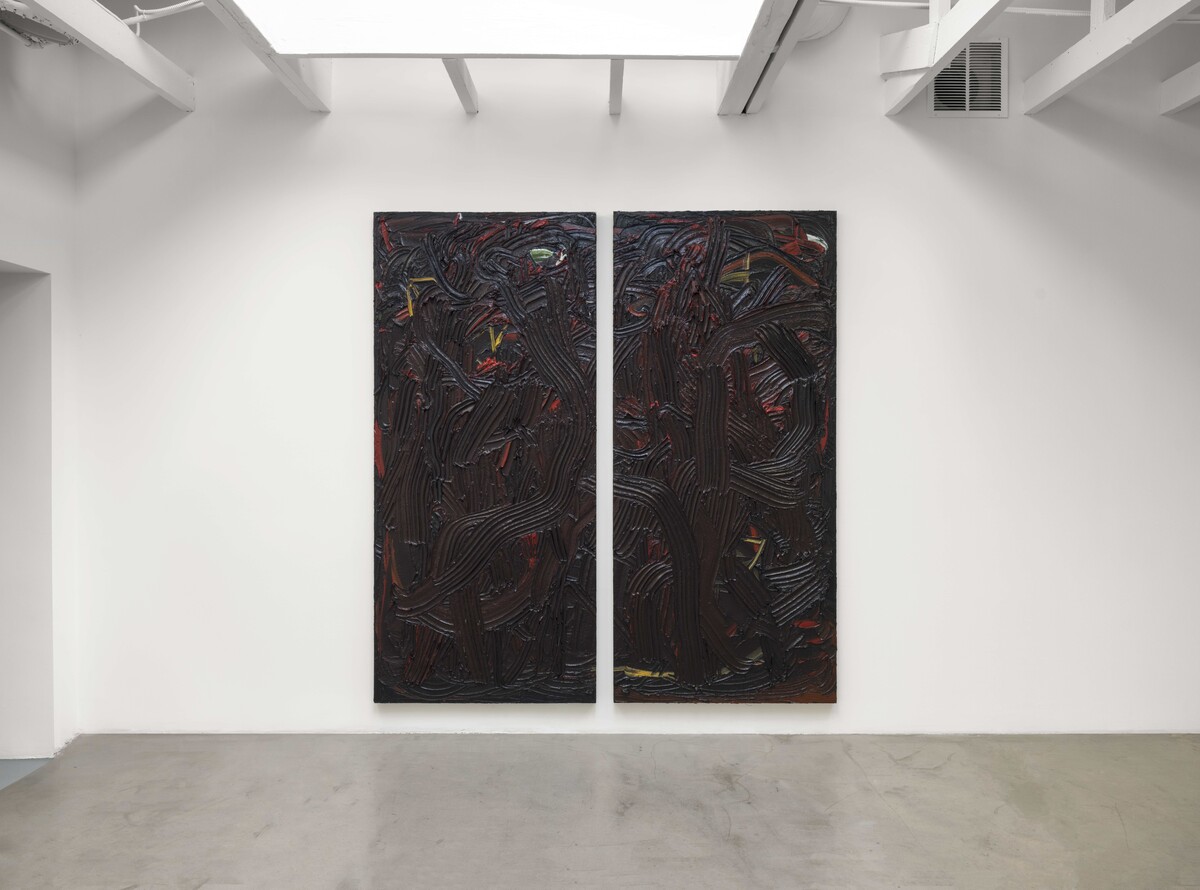
An accumulation of wait will hold both a psychological state and a material condition. Thought and emotion move through the work while paint remains liquid, open to change. Paint accumulates, hardens, and takes on a physical form as an image is found through material. Time becomes weight.
Yossifor’s work has become increasingly both pictorial and physical. In this new body of work, those two directions pull harder against one another, approaching images as relics, reliefs, and objects. Paint is scraped, brushed, finger-painted, and pulled from one painting to another, with its limitations determining what can appear. What is open and possible while wet becomes closed and final as it hardens.
In one of the exhibition’s most physically imposing works, painting pretends to be sculpture while trapped in an anxious stasis. Dried paint scraped from a previous painting is returned to the surface and covered again. Its remains push through the new layer, the scrapes visible like scabs. The painting carries its own past materially; something removed is accumulated again, buried without disappearing. There is an archaeological logic to this process, but the excavation produces rather than recovers the image. The image is built from these remains.
Included in the exhibition are several smaller works that shift both scale and register. Tighter and more contained, they introduce a distinct and unexpected use of color. Lines are indented, etched, and drawn into the paint, from which figures, rooms, and scenes take shape.
Yossifor’s movement between image and object has precedents in the dense, wounded surfaces of Jean Fautrier’s postwar paintings and his haute pâte technique. Jay DeFeo’s repeated acts of accumulation and removal provide another point of contact. Martin Wong’s early sculptures offer an inverse relation, physical objects that nevertheless retain the frontality of paintings. To make them is also to wait.