
The sound of keys in the door is heard, and then the door opens, then closes. A sigh escapes through delicate lips. Shoes click across the wooden floor. A purse is tossed onto the couch, and a body lowers itself into the cushions, exhaling into their give. The dark outside peers in through open curtains. The lights of passing cars cast shifting shadows across the room. A car horn sounds in the distance. Eyes drift around the room, tracing an invisible line—from the end table to the wall, up the wall to the framed picture, to the doorway, to the kitchenette, to the small dining table, to the flowerpot, to the window, to the small sink. All the common actors waiting for her return, day after day. Poised and unmoving; familiar statues in a garden.
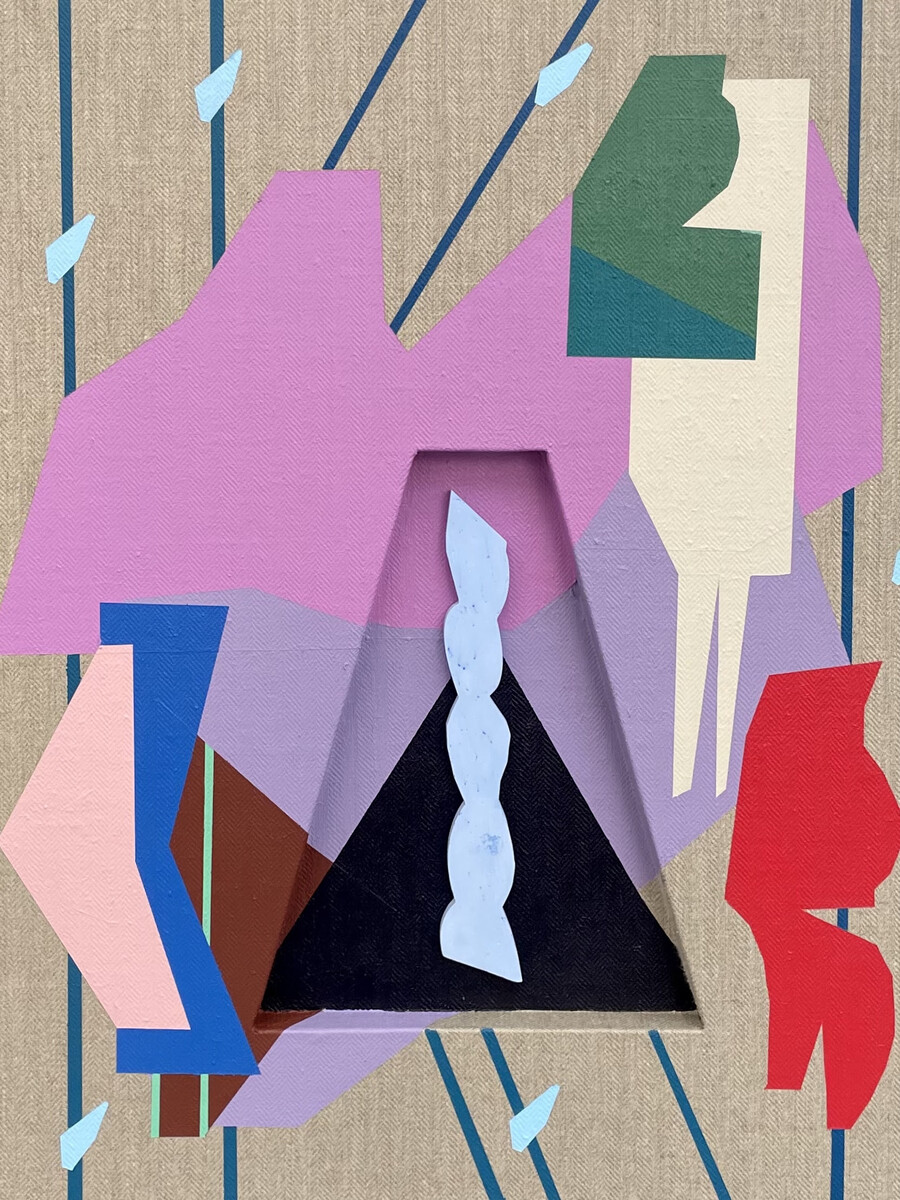
Caroline Kent presents A Light Left on in the Hallway, a new body of paintings that shifts in scale from the intimacy of a sheet of stationery to a building’s relief that towers overhead. Bridging past and present gestures—much like a hallway joins one room to another—Kent frames growth as a process of repetition and return. The exhibition’s title serves as a quiet summons, evoking the hour late at night or just before dawn: a dim corridor where shadows lengthen, dissolve, and gather again. Within this transitional architecture of light, painting becomes both witness and companion.
Kent’s compositions are informed by American black-and-white cinema of the 1950s and ‘60s. When paused, a film frame resolves into a carefully composed field of tonal relationships, where gradients of gray distribute themselves evenly across the picture plane. Intimate domestic details—a lamp on an end table, patterned curtains, a dress, a hat resting on a mantel—occupy the same flattened register of light and shadow, bound by gradation rather than depth. Echoes of these interiors surface throughout Kent’s titles and compositions, suggesting scenes that feel both known and perpetually out of reach.
In translating this cinematic logic into paint, spatial illusion collapses into a two-dimensional surface. Forms flatten into color. At times, the movement reverses: space opens inward, receding into a carved recess within the canvas to form a niche. This sculptural device, first introduced in Kent’s interventions on gallery walls and later in wooden constructions, now enters the painting itself, creating literal depth. An enigmatic motif, initially developed in cut paper and later in paint, is cast in pigmented cement and set into the recess. Both embedded and elevated, it holds its quiet significance in high relief, like a treasured relic.
The works on Belgian linen are taut, brightly colored compositions that pulse against the soft herringbone weave of the cloth. Kent embraces repetition without exactitude; her hand welcomes subtle deviation. Forms recur like remembered phrases, altered slightly each time they are spoken. Small recesses, seductive in their shifting contours, punctuate the surface and draw the viewer inward, beyond the painting’s façade. Shapes move across the plane and through its depth like devoted wallpaper brushing over dormant sockets and past inhabitants. These works require no unwrapping; their intimacies are worn openly, their secrets resting lightly at the edge of disclosure.
A series of linen compositions are inset within richly stained wooden panels, where herringbone cloth, porous dyed concrete, slick acrylic, and smooth walnut enter a languid dialogue as if speaking one mother tongue in varied dialects. Each material absorbs and reflects the presence of the others. Geometric lines yield to the wood’s natural grain as polished edges meet softened fibers.
In contrast, Kent’s large-scale unstretched canvases expand this intimate register into something operatic. Released from the constraint of the weave, sweeping black grounds generate fields in which shadowed forms collide, overlap, and fragment. Dashes and lines traverse saturated planes of color, functioning less as ornament than as architecture. Linear frameworks shift perspective, capturing forms in veils of black that pull them into deeper spatial registers, testing the stability of the structure. Just as order begins to surface, Kent’s abstract language unsettles it. Patterns cohere, then dissipate, like flickers from passing headlights. Gestures slip in and out of darkness as they hover between intention and discovery. A chapel in the center of the city that only appears in the dark (2026) names this phenomenon—a site that exists only in memory, imagination, or the hush of a midnight dream.
Across scales, Kent’s motifs (like language, like thought, like feeling) evolve while retaining the imprint of their first impulse. These paintings are not puzzles to be solved but presences to be kept company with. Like a single light left on in a hallway, they mark a threshold between solitude and return, between what is seen and what is felt. In Kent’s hands, abstraction becomes deeply romantic: an art of shadow and illumination.