
Why One Artist Transcribed All 900-Plus Pages of ‘Moby-Dick’ by Hand
The New York Times Style Magazine / Mar 4, 2026 / by Elly Fishman / Go to Original
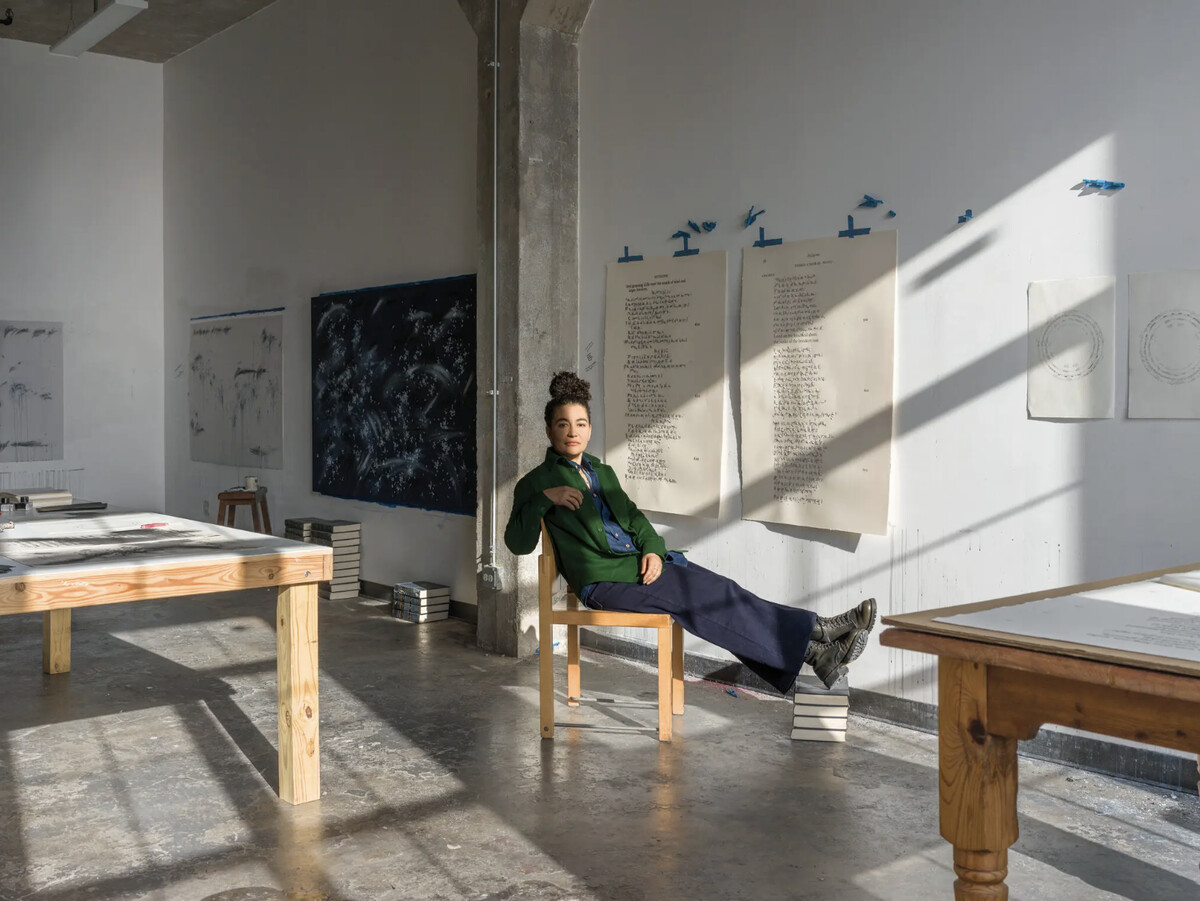
For four months, beginning in the summer of 2024, the Chicago-based artist Bethany Collins woke up every day before dawn, brewed coffee and sat down at her dining table to copy out Herman Melville’s “Moby-Dick” (1851) with a nib pen. Writing in midnight blue acidic ink on onionskin paper, she made her way through the book’s 900-plus pages 10 at a time. The resulting work, “Or, the Whale, Vol. I-III,” is housed in three black clothbound binders. “It felt ritualistic,” says Collins, 41, of the project, “like meditation.”
Collins, who grew up in Montgomery, Ala., and was raised in both evangelical and Presbyterian churches, was drawn to the novel in part because it has been described as “America’s Bible.” Her daily scrivening practice was inspired by the American conceptual artist Allen Ruppersberg, who in 1974 copied Oscar Wilde’s novel “The Picture of Dorian Gray” (1891) across 20 6-by-6-foot canvases in longhand using a Pentel marker. “Ruppersberg talks about transcription as the most intimate you can become with an author,” says Collins. “I’m enamored with that idea.”
Immersing herself in Melville’s text, she found “Moby-Dick” to be rife with 200-year-old anxieties that still echo today: The book warns “against following the lone madman who will take the whole ship down,” she says, noting that Melville also points out the dangers of “overconsumption, the pursuit of oil and an obsession with whiteness.” As Americans, “all of those obsessions and pursuits are somehow uniquely ours,” she says.
Such portents of history are often embedded in her work, which has been shown in solo exhibitions at the Peabody Essex Museum in Salem, Mass., and the Seattle Art Museum, among other institutions. For another series, she used the score for the American composer Stephen Foster’s “Beautiful Dreamer” — an 1864 ballad sometimes interpreted as a serenade to a dead lover — to create target-shaped prints and then enshrouded them in cloudy drawings meant to evoke plumes of tear gas. Those all will be on view in Collins’s forthcoming show at the Museum of Contemporary Art Denver, although, compelled by America’s ongoing political uncertainty, she opted to include only two volumes of “Or, the Whale” because “we don’t know how this all is going to end,” she says. “I’m not an optimistic person, but the work implies that there will be a future. That feels hopeful.”
Can Brands Crack LA Art Week?
Vogue
Mar 2, 2026
Mar 2, 2026
Charisse Pearlina Weston Named 2026 Hermitage Greenfield Prize Recipient
Sarasota Magazine
Jan 22, 2026
Jan 22, 2026

How Alex Chitty and Norman Teague Chair-ish What We Sit On
Newcity Art
Jan 21, 2026
Jan 21, 2026
11 art exhibits to explore this winter
wbur
Jan 13, 2026
Jan 13, 2026
Simon Benjamin Confronts an Island Iconography for Colonial Minds
FRIEZE
Jan 13, 2026
Jan 13, 2026