Nyeema Morgan and Mike Cloud Turn the Neubauer Collegium Into a Riddle
New City Art / Jun 15, 2026 / by Lucas Gomez-Doyle / Go to Original
Of all the enduring predicaments that continue to reverberate across the contemporary art world, questions of meaning-making and intended function are perhaps the most tantalizing. Without pause, each generation has received these concerns, awaiting these beguiling dividends in hopes of finally putting the nightmare (or dream!) to bed. In tow, a slurry of enthusiasts—scholars, artists, critics, visitors—have gambled away their time in attempts to make sense out of sense. Never bet against the house, they say.
Given this infinite loop, one might suspect material that approaches this threshold to be tedious; venture to the Neubauer Collegium for Culture & Society’s latest exhibition, a double-headline of Nyeema Morgan and Mike Cloud entitled, “Story Structure, Pt. 2,” and you’ll find that this is not the case. In fact, it’s completely the opposite. In a cerebrally dexterous and elastic display, the two artists have outmaneuvered the field, flanking normative conventions of “meaning” from its literal and conceptual margins. How refreshing to be in their presence.
To stumble upon the work of Morgan and/or Cloud is to feel like you have been subbed in during a momentous soccer game in the dwindling minutes of stoppage time. That is, action is pressingly required. Visitors must then, with palpating hearts, clammy palms and perspiring foreheads, forge ahead and get to work. Doing what exactly? Deciphering all the signs and symbols that appear in their midst.
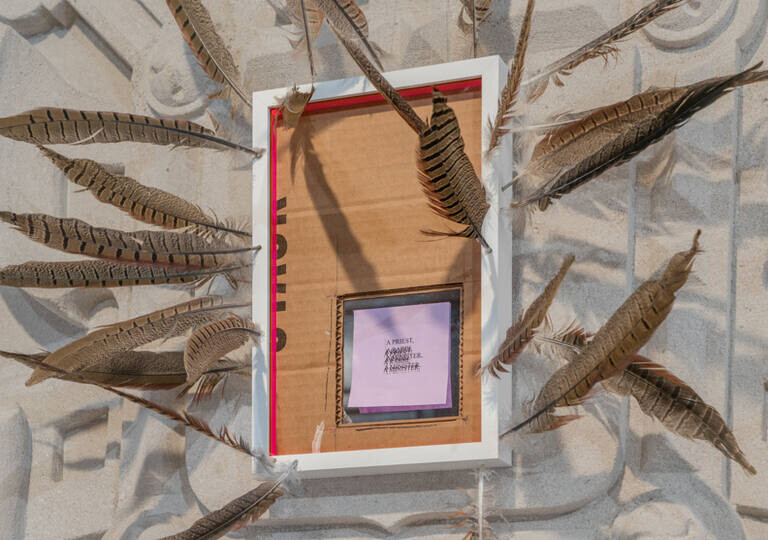
The room, which contains pieces by Morgan and Cloud, respectively, and one jointly created by the duo, requires sturdy concentration. Take, for example, Morgan’s ongoing “studies for traps,” recognizable for its white frames and colored Post-It notes paired with concise phrases, which accent the space. Each work, often containing more than one pocket-square of paper, is a nesting doll of frames. The typical construction is as follows. A framed border marks the exterior limit. Inside, a series of notes, each of which, although sometimes the notes themselves are absent, is framed by yet another smaller boundary. In some cases, these miniature perimeters contain a unique background picture and a written message so that when all is said and done, there are four or five layers. Frames that frame frames are framed by frames. It’s incredible.
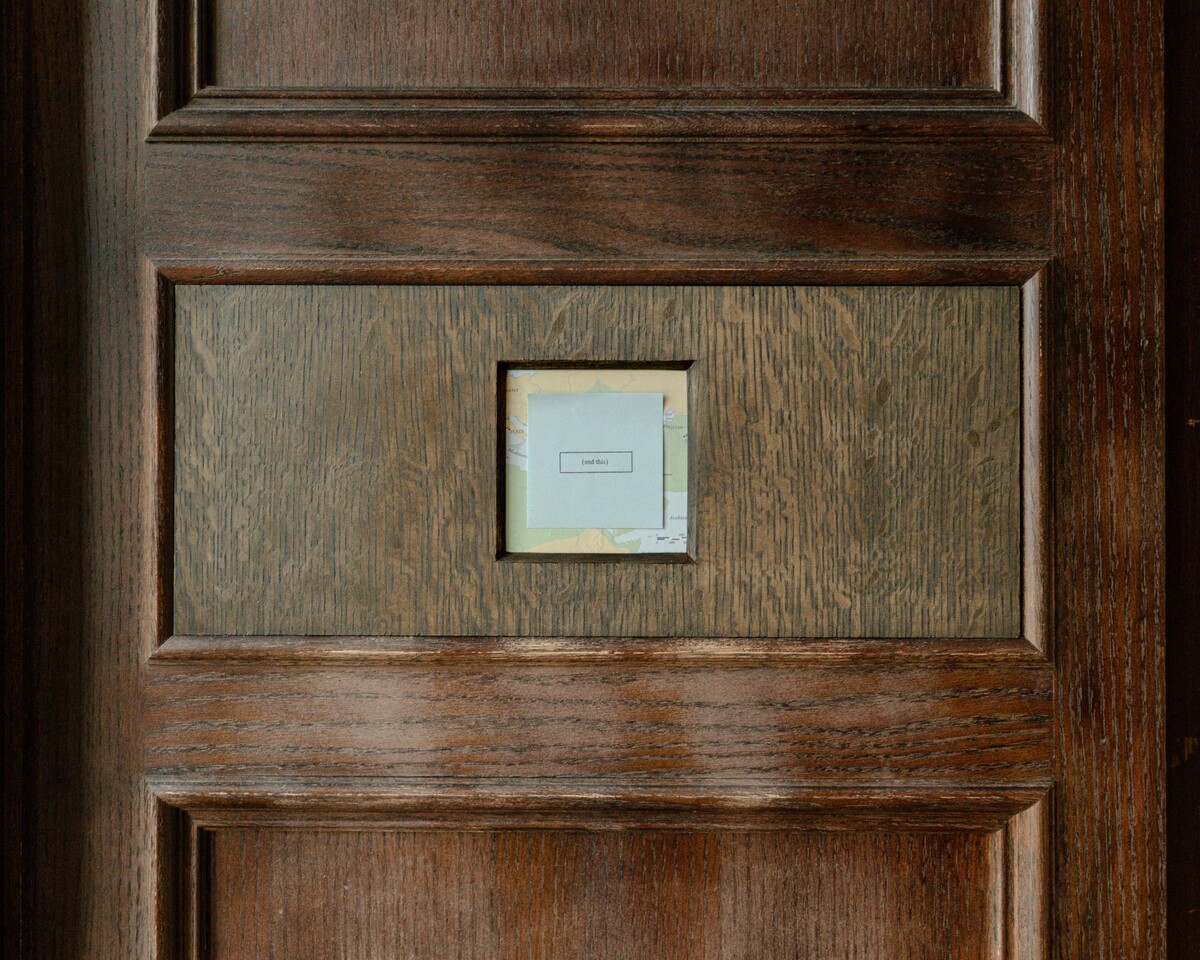
But there’s more because Morgan has dug deeper with a site-specific rendition, one which uses the wooden walls of the Collegium’s exhibiting space as a Trojan Horse. Choosing an off-colored and grain of wood that is eerily similar to the surrounding environment, Morgan has taken inserts and embedded pieces into many of the square openings within the room’s interior facade. In all but two of these iterations, a single image serves as the focus over which a Post-it note has been added. More like veils than anything else, these visual impairments serve to suppress, supersede or shadow the visual entities they partially conceal. This additive coverage challenges total recognizability and with it any assurance over what might be hidden.
To interact with Morgan’s work thus requires a jumping-through obscurity into the preceding elusive plane. This suspension of perceptual access means that a viewer and only a viewer is responsible for settling on an estimation. Draw your conclusion and find out what you’re made of Morgan reveals.
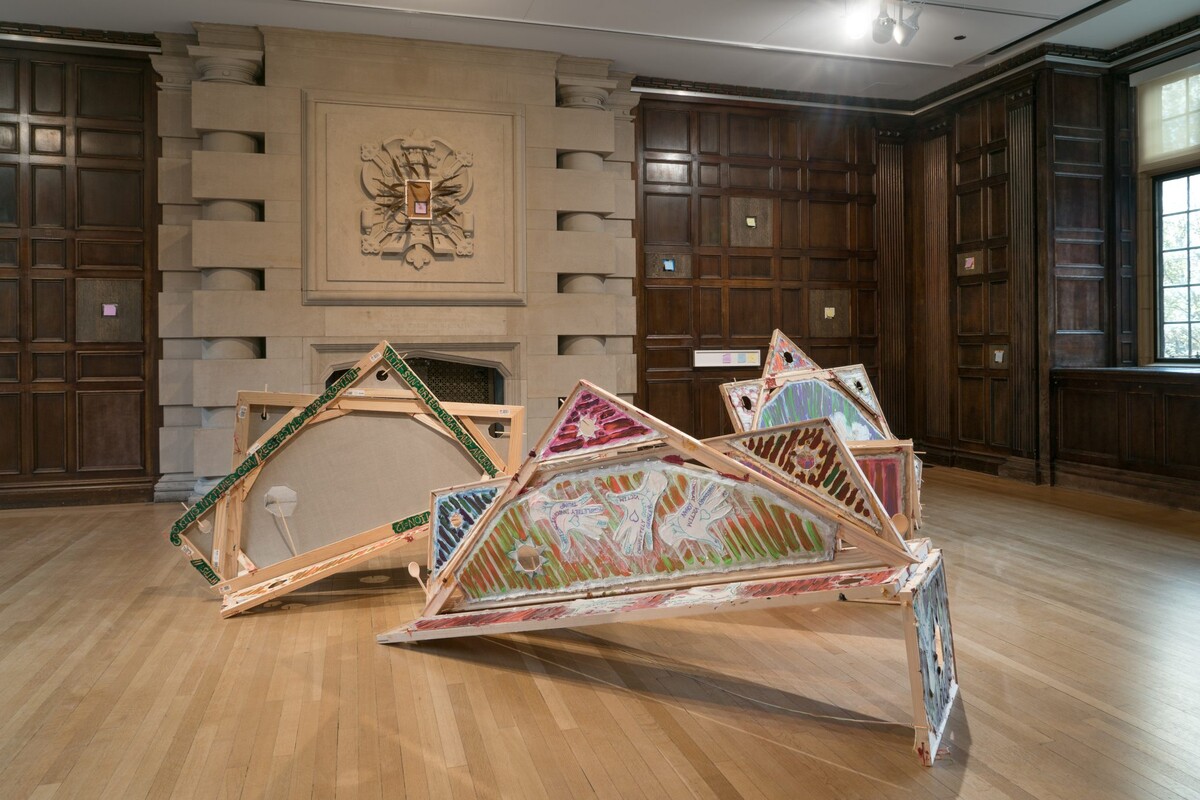
If Morgan forms an outer rhythm rippled by linguistic determinants and visual eclipses that hopscotch in and out of sight, then Cloud’s paintings, all three of which are in the middle of the room, offer an inner melody syncopated by color making for an equally enticing trio of lures. Cloud’s art stands out for its ludic experimentation with the medium’s integrity, so transfixing in shape that the press release described them as “a herd of meekly grazing stegosaurs.” Or perhaps, given this theme, a fitting account could be that they also resemble the skeletal remains of dinosaurs from eons ago, some atavistic grouping that requires viewers to adorn a raggedy hat and call themselves Indiana Jones or conceive that this would have made for far better content than what was in “Jurassic World: Rebirth.” And, if they were to be bones, that would be yet another unearthing of a frame within this excavated milieu.
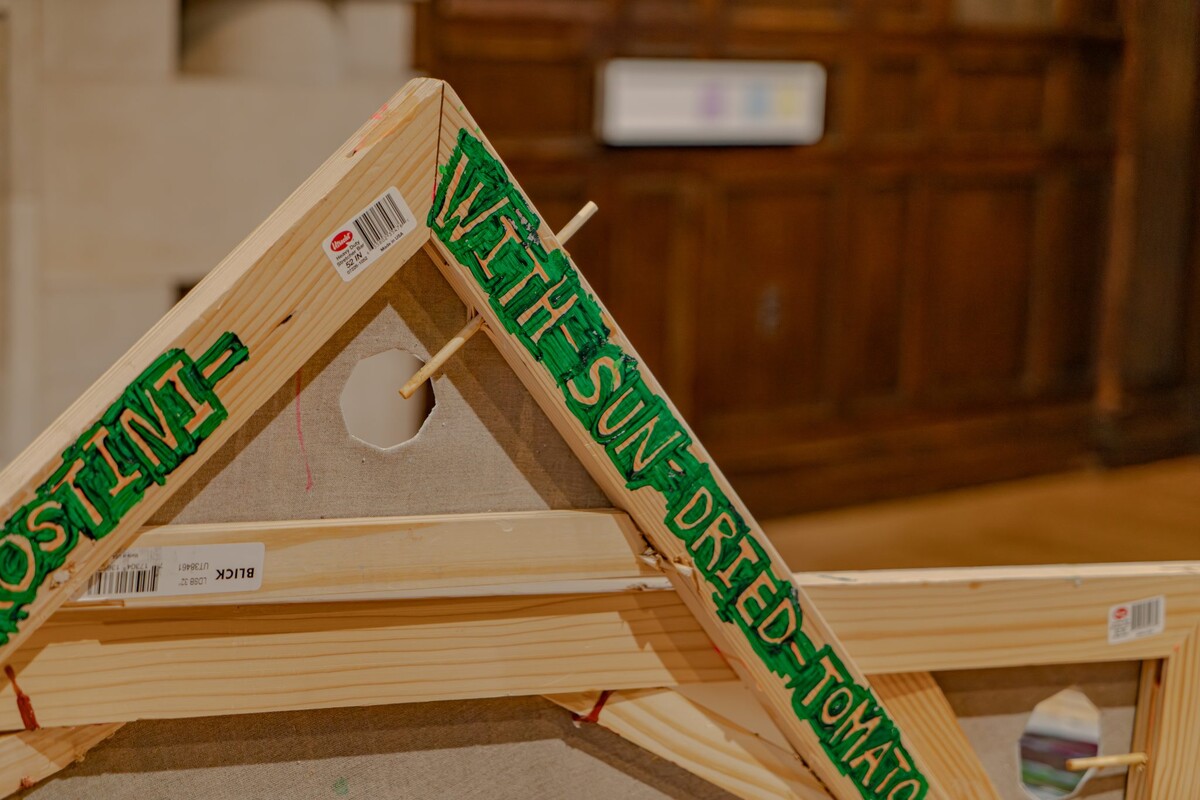
The works themselves are frame-forward. Metal hinges conjoin portions together while the non-painted edges of the paintings are populated by Blick stickers–tattoos capitalized by a permanent reminder of corporate patronage. The canvases, areas made where the frames have dissected through each other, are executed with hand-painted stripes rich with a felicity for color theory. Often, Cloud has arranged and pasted cut-out hand turkeys on these parts, a practice taken right out of middle-school activities. No less peculiar is the inspiration for each piece, the result of a New York Times search for the word “sun.” The solar outcomes are diverse. One of the results is a recipe for crostini with sun-dried tomatoes and anchovies. (For those curious, the recipe supposedly takes twenty minutes and yields four servings.) Another outcome, the organizational and fiscal ongoings of Sun Country Airlines, is less appetizing. Wooden spoons stirringly appear, culinary appendages that serve to mix the matter further.
Then there’s the collaboration, a sound installation activated by kinetic motion in front of the room’s fireplace. Voices callout stories that begin with, “An artist I know.” Myth and mystery pour out. Comically, you can also hear the piece in the bathrooms one floor below. So, be sure to make a stop before you leave, context changes everything, or so we’re told. Investigation, it’s a long game of hide-and-go-seek.
Mike Cloud & Nyeema Morgan’s “Story Structure, Pt. 2” is on view at the Neubauer Collegium for Culture and Society, 5701 South Woodlawn, through June 28.
Chair-ish: Alex Chitty | Norman Teague
Cleve Carney Museum of Art
Mar 6, 2026
Mar 6, 2026
Why One Artist Transcribed All 900-Plus Pages of ‘Moby-Dick’ by Hand
The New York Times Style Magazine
Mar 4, 2026
Mar 4, 2026
Can Brands Crack LA Art Week?
Vogue
Mar 2, 2026
Mar 2, 2026
Charisse Pearlina Weston Named 2026 Hermitage Greenfield Prize Recipient
Sarasota Magazine
Jan 22, 2026
Jan 22, 2026
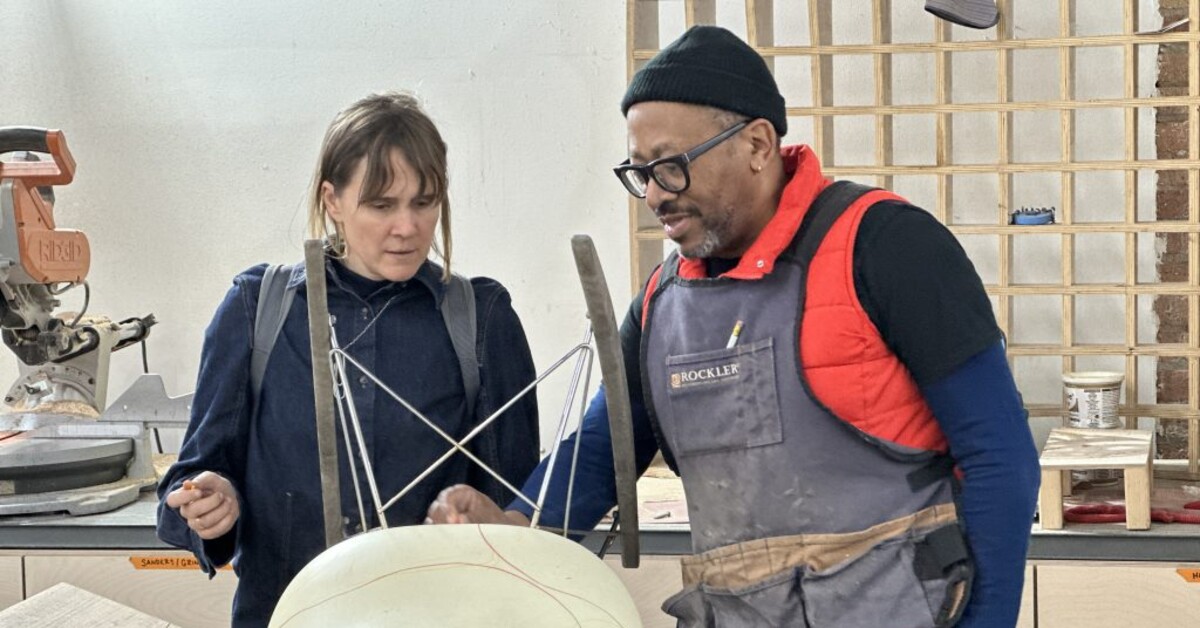
How Alex Chitty and Norman Teague Chair-ish What We Sit On
Newcity Art
Jan 21, 2026
Jan 21, 2026