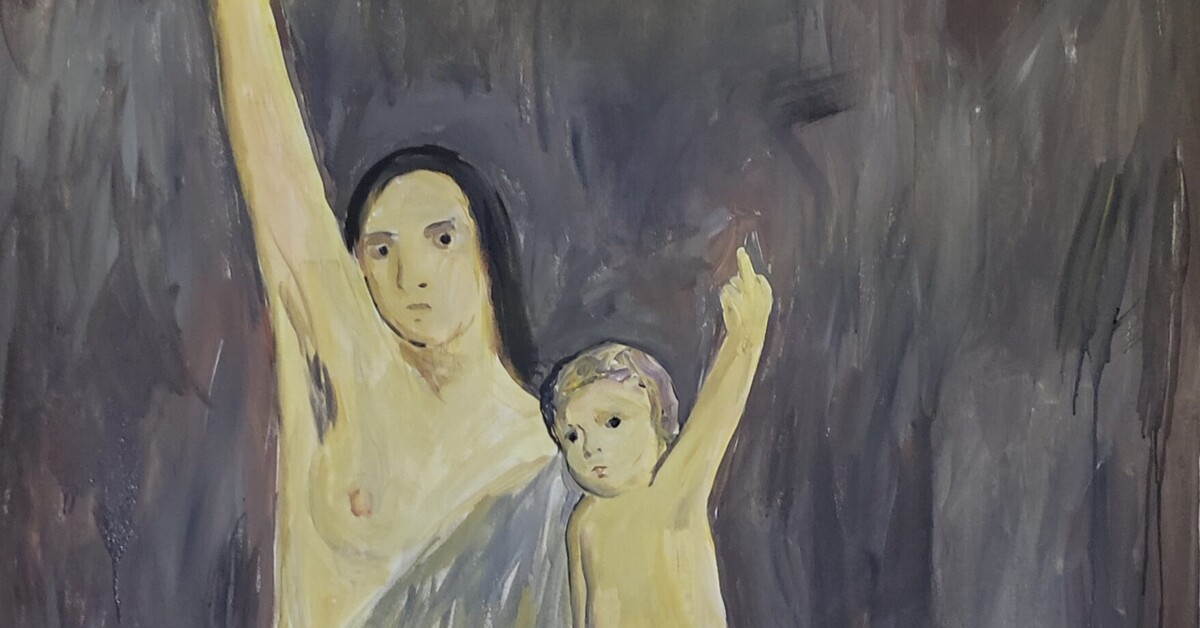
On friendship: Gertie’s curatorial director muses on the distance between friends.
Chicago Reader / Aug 3, 2026 / by Gareth Kaye / Go to Original
“What is a friend
How do you get a friend
How do you keep a friend
How come I don’t have a friend?”
—Dr. Steve Brule
“Friendship, this relation without dependence, without episode, yet into which all of the simplicity of life enters, passes by way of the recognition of the common strangeness that does not allow us to speak of our friends but only to speak to them… . ” —Maurice Blanchot
Drunk on sunlight, we reacquaint recumbency with soil rather than sofa. Condensation from a beverage, cooler than the heavily saturated air, coats our palms. At Promontory Point, in the parks, on the patios, and along the boulevards, we spend our summers observing and partaking in these scenes, surrounded by good company. This current, all-too-brief interval from June to early September in Chicago is socially gluttonous, before the shortened days find us reacquainted with our more antisocial impulses. This culturally accepted window of reprieve from the Protestant work ethic dissipates as the calendar pitilessly advances toward autumn, and time with friends gives way to the specter of familial obligations that pockmark the end of the calendar year.
So while the sun stays out past eight, the boulevards remain verdant, and the waits for a bus, train, or rideshare are meteorologically tolerable intermissions where vitamin D abounds, I would like to make some observations on those inevitable others with whom we are passing these days. For those of us lucky enough to identify those with whom we are on friendly terms, the fact that somewhere between 15 and 20 percent of Americans report having no close friends might seem unthinkable. But if we consider how friendship is often portrayed in the mainstream, as a largely frictionless relation with some sort of mirror to our own subjectivity, it might make sense why it feels hard to relate to anyone. If we’re looking for others to mirror some preconceived notion we have of ourselves, the pursuit of friendship is a waste of time. Between the words of Maurice Blanchot and Dr. Steve Brule, it seems as if the true friend is more of a vexation in our midst than an answer for our isolation.
What distinguishes friendship from family is that family carries a sense of continuity, genealogical accounts, and varied, if unreliable, histories. Friendship has none of these things to account for. In fact, its elective and aleatory nature leaves it with little beyond its own perpetuation. Rather than emerging from a probable procession of names and generations, friendship is sparked by an abrupt and sudden interruption; a relationship between differing fragments in a shared context. We bump into our friends, no matter how long we’ve had them, as if out of the blue. Friendship, like summer, is in its best instances a momentary dissolution of obligation.
Should you (and ideally a friend) trek to Patron before August 22, you’ll be sure to observe the distinctive dilemmas of friendship firsthand in “Let’s Go Exploring!,” an exhibition of work by Tony Lewis and Gregory Bae. For context, Bae and Lewis both met in the School of the Art Institute of Chicago, each receiving their MFA in 2012. For a period of time during their lives, they shared a studio, and following Bae’s death in 2021, they shared a studio again, with Lewis accepting responsibility for storing the contents of Bae’s life and practice—the border between the two being nebulous.
The crux of the show presents a fairly straightforward exhibition of completed artworks from their respective makers, while leaning a bit more favorably towards Bae insofar as the number of objects is concerned. The exhibition includes painted tires; a drawing of the clouds from the opening credits of Groundhog Day; a flag of the night sky mounted under a rotary fan; an inflatable globe; a film synchronizing the rising sun in Chicago with it setting in Milan; and shards of language from instruction manuals styptically appliqued back together in arrangements that look like musique concrete scores. The heterogeneity of Bae’s work stands in clear contrast to Lewis’s systematic, decades-long involvement with pencil and paper. Their few commonalities exist by this same medium. Lewis and Bae are mutually adept draftsmen; a shared appreciation for drawing as both preliminary and executive action pervades, as does an affinity for Bill Watterson’s Calvin and Hobbes, which is apt for considering the friendship between a boy and a tiger who both is and is not present—mirroring Lewis’s own ongoing repartee with Bae, who himself is both here and away.
In the eponymous and final essay of his 1971 collection, Friendship, literary critic Blanchot concisely, but movingly, grieves the passing of his friend, the writer Georges Bataille. Blanchot speaks of the loss of a friend not as an insurmountable gap between the two, but as a collapse of vital distance that forms the basis of a living friendship, writing that when friends are no longer with us, we lose that distance that makes them they and us ourselves. Left only with what could be considered the conclusion of a relationship that is in itself fragmentary, we no longer have a friend to speak to, but rather speak of. Our memories and recollections cease to be two-sided conversations, but rather recapitulations of a single perspective. In doing so, we inadvertently speak only of ourselves, of the friend’s qualities, memories, and characteristics that were what we knew them for, and not the unspeakable, or unknowable differences that were perhaps never items of conversation, but upon which the foundation of our familiarity rests so comfortably.
Along a wall facing the gallery’s long Chicago Avenue storefront windows is a smattering of paintings, drawings, papers, canvases, photos, collages, notes, and plans for works and cocktails both realized and deferred. Unless you’re consulting the checklist or are particularly familiar with each artist’s output, it can be difficult to discern who made what, and even with the aid of references or a priori know-how, the task can be tricky at times.
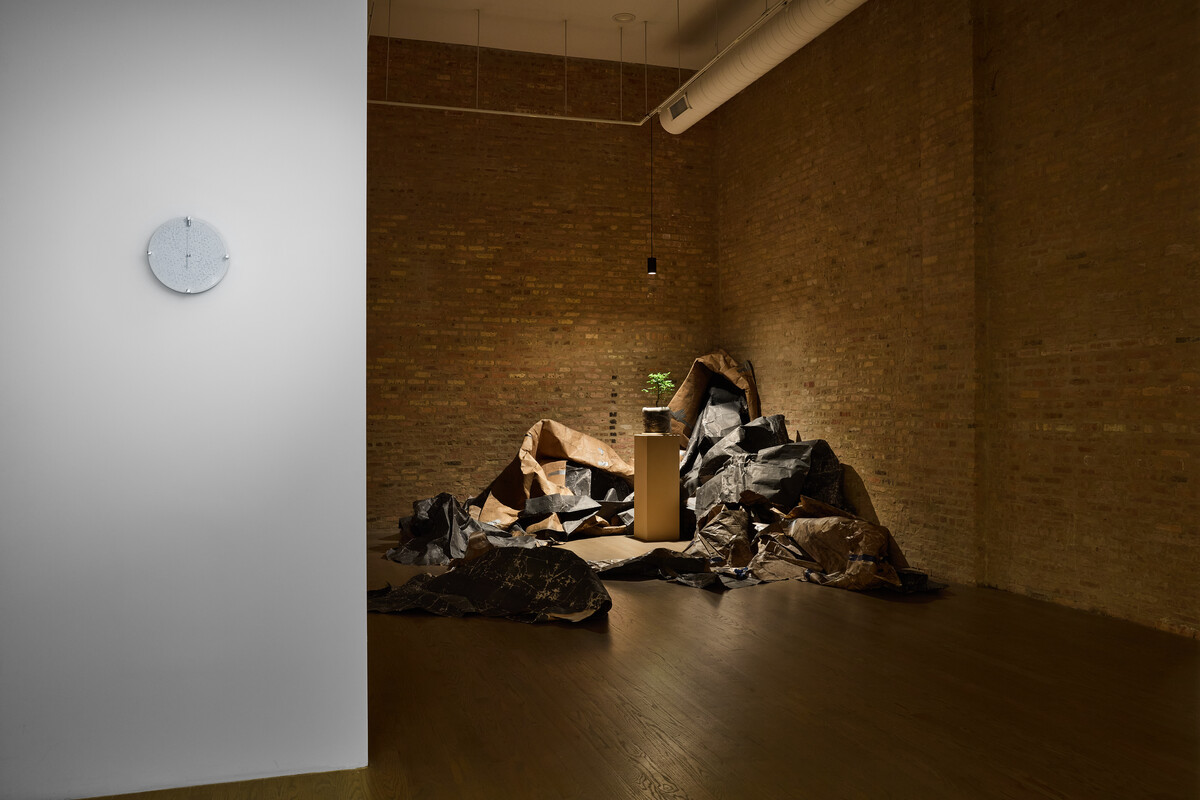
Meanwhile, in Patron’s dimly lit rear gallery, crumpled ashen tentacles of paper ring the periphery of a pedestal where a Bonsai tree grows, nurtured by a lone UV bulb whose ward springs from the earth dislocated into a plastic shopping bag. Dirt of Opportunities #2 and Untitled 4, Bae and Lewis’s respective contributions couldn’t have anything less to do with one another, and that is perhaps why they sit so comfortably in their respective ambivalence. It’s in the sparse moments here at the back, and the fullness apparent at the gallery’s front, that the incommunicable and asymmetrical gaps that determine a friendship appear as a series of reciprocal and varyingly opaque points of relation. The integral distance that may have existed between Lewis and Bae is vividly renewed between the tension of their works in situ. All the tenderness that one could reasonably expect from a more resonant pairing emerges here from their remarkable distinction. A rubbing of a basketball court in Belgium and a tree growing from plastic is no less incongruous than a boy and a feral tiger.
Chair-ish: Alex Chitty | Norman Teague
Cleve Carney Museum of Art
Mar 6, 2026
Mar 6, 2026
Why One Artist Transcribed All 900-Plus Pages of ‘Moby-Dick’ by Hand
The New York Times Style Magazine
Mar 4, 2026
Mar 4, 2026
Can Brands Crack LA Art Week?
Vogue
Mar 2, 2026
Mar 2, 2026
Charisse Pearlina Weston Named 2026 Hermitage Greenfield Prize Recipient
Sarasota Magazine
Jan 22, 2026
Jan 22, 2026
How Alex Chitty and Norman Teague Chair-ish What We Sit On
Newcity Art
Jan 21, 2026
Jan 21, 2026